
Outgoing Chief Justice of India BR Gavai defends the Supreme Court's verdict on governors' powers, emphasizing the principle of separation of powers and judicial independence.

Security at the Raj Bhavan in Thiruvananthapuram has been stepped up after a caller from a Gulf country issued a threat to the life of Kerala Governor R S Gavai, police said on Monday.

Chief Justice of India (CJI) B R Gavai on Saturday said he will do consultation and arbitration after his retirement, and will not accept any government post.
The Kerala state governor R S Gavai has allowed the prosecution proceedings against the Communist Party of India-Marxist Kerala state secretary Pinarayi Vijayan, who was the power minister in the E K Nayanar cabinet during 1996.
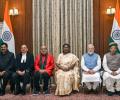
The Supreme Court's opinion on the presidential reference can impact on any number of cases if and when governors, if not the President, take a literary view of the Supreme Court's 'ppinion' on their 'discretionary powers' without reference to the rider on 'reasonable time', points out N Sathiya Moorthy.
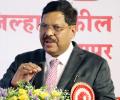
Chief Justice of India Bhushan Ramkrishna Gavai spoke about Dr. B R Ambedkar's views on the supremacy of the Constitution and the need for an independent judiciary.

The Centre has opposed the imposition of fixed timelines on governors and the President for decisions on bills passed by state legislatures, arguing that such constraints were intentionally omitted by the Constitution's framers.
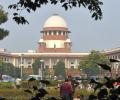
A Constitution bench comprising Chief Justice B R Gavai and Justices Surya Kant, Vikram Nath, P S Narasimha and A S Chandurkar, would fix the timelines on July 29 and commence hearing on the presidential reference in mid-August.
BJP-ruled states argued in the Supreme Court that governors and the President have autonomy in assenting to bills passed by state assemblies, asserting that courts cannot mandate assent.

CJI Gavai said that as head of the Judicial Infrastructure Committee he had prepared a model of setting up new taluka and district-level courts

The Supreme Court on Thursday refused to accept the preliminary objections raised by opposition-ruled states like Tamil Nadu, West Bengal and Kerala to maintainability of Presidential Reference, saying the issues raised in it pertain to the very core and foundational modalities of the constitutional machinery.
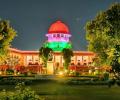
The Centre told the Supreme Court that governors are not indefinitely sitting on bills passed by state legislatures, and that barring a few exceptions, most have acted in a way which the apex court would have perhaps desired. Solicitor General Tushar Mehta argued that a Governor is "not a rubber stamp" and has a duty to preserve, protect, and defend the Constitution.
The Supreme Court has scheduled hearings starting August 19 for the Presidential Reference concerning constitutional issues related to timelines for handling bills passed by state assemblies. The court has directed the Centre and states to submit written arguments by August 12.
The Supreme Court is hearing arguments regarding a presidential reference on whether fixed timelines can be imposed on governors and the president for acting on bills passed by state legislatures. The court is considering objections to the maintainability of the reference under Article 143 of the Constitution.
The Centre has told the Supreme Court that imposing fixed timelines on governors and the president to act on bills passed by a state Assembly would amount to one organ of the government assuming powers not vested in it by the Constitution and lead to a "constitutional disorder".
The Tamil Nadu government has urged the Supreme Court to dismiss the Presidential reference concerning the Governor's powers to assent to bills, arguing it is an 'appeal in disguise' to overturn settled law.
The CPI(M) today observed 'Black day' in Kerala in protest against Governor R S Gavai's decision to accord sanction to the CBI to prosecute former Minister and party's state secretary Pinarayi Vijayan in the SNC Lavalin graft case.
Senior Congress leader Oommen Chandy was sworn in as the 21st chief minister of Kerala on Wednesday at the Raj Bhavan in Thiruvananthapuram. Along with Chandy, six floor leaders of the United Democratic Front coalition were administered the oath of office and secrecy by Governor R S Gavai at the lawns of the Raj Bhavan.
The split in the Kerala Communist party of India - Marxist grew wider on Wednesday, with Chief Minister V S Achuthanandan defying the politburo line on Governor R S Gavai's decision to give sanction to prosecute Secretary Pinarayi Vijayan in a corruption case, saying it neither shocked nor surprised him.

He could have blazed a trail that few Indian judges had. It was a missed opportunity of a lifetime, notes Ramesh Menon.
The Central Bureau of Investigation on Thursday filed a chargesheet against Communist Party of India - Marxist Kerala Secretary Pinarayi Vijayan in a graft case. After receiving Governor R S Gavai's sanction four days ago to prosecute 69-year-old Vijayan, overruling the state cabinet recommendation, the CBI filed the 11-page chargesheet in a special court in Kochi, naming Vijayan and eight others as accused in the case.
